
VASCULITIS
Vasculitis is the collective name for a group of serious, chronic auto-immune diseases in which the wall of the blood vessels gets inflamed.
Vasculitides (plural of vasculitis) can occur as a standalone disease of unknown cause or as a side effect of another disease.
In the former case we speak of a primary vasculitis, in the latter case of a secondary vasculitis.
Sometimes a vasculitis only occurs in a certain part of the body. However, it often shows itself in a form that can occur throughout the body. We then speak of a systemic vasculitis.
Vasculitis International mainly focuses on the primary, systemic types of vasculitis.

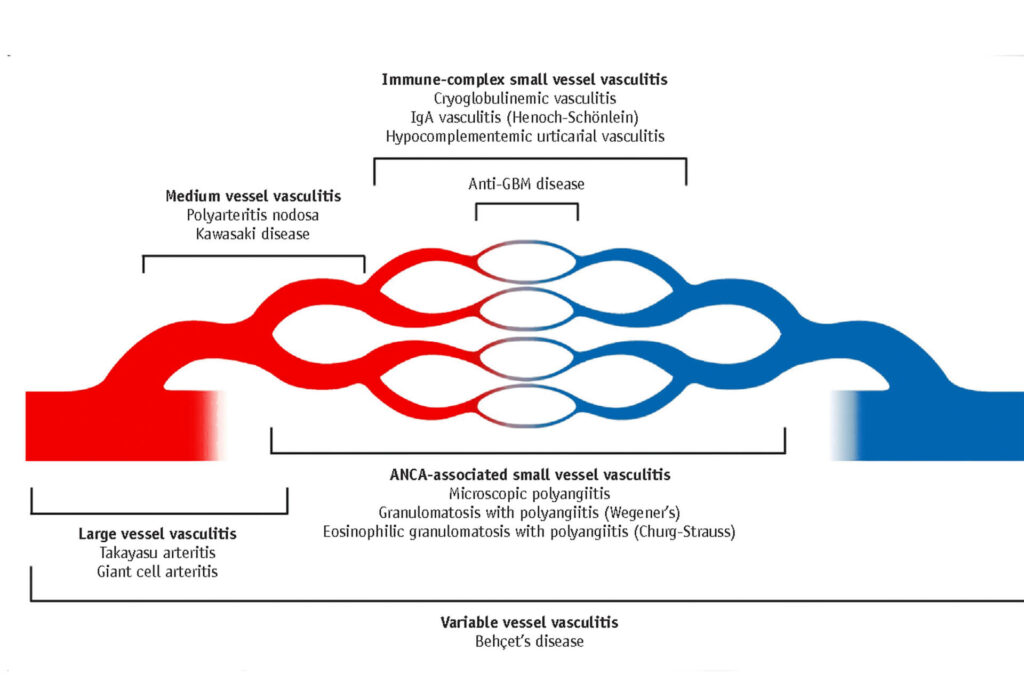
The so-called Chapel Hill classification defines the different types of vasculitis according to the size of the blood vessels affected.
LARGE VESSEL VASCULITIS (LVV)
MEDIUM VESSEL VASCULITIS (MVV)
SMALL VESSEL VASCULITIS (SVV)
- GPA Granulomatosis with Polyangiitis (Wegener’s)
- EGPA Eosinofile Granulomatosis with Polyangiitis
- MPA Microscopic Polyangiitis
(collectively referred to as ANCA Associated SVV)
- Anti GBM Disease (Good Pasture)
- IgA vasculitis (Henoch-Schönlein)
- CV Cryoglobulinemic Vasculitis
- Anti C1q vasculitis
(collectively referred to as Immune Complex SVV)
VARIABLE VESSEL VASCULITIS
SPECIFIC ORGAN VASCULITIS
Cutane leukocytoclastic angiitis (CLA), Cutane Arteritis, Primary CNS vasculitis, Isolated Otitis, and other.